Install & first launch
PLASMA runs a local web server and opens in your browser at
http://127.0.0.1:7860. Nothing leaves your machine.
Get PLASMA
Download the asset for your platform from the latest release:
| Platform | Asset |
|---|---|
| macOS (Apple silicon) | PLASMA_MacOS_arm64 |
| Linux (x86-64) | PLASMA_Linux_x64 |
| Linux arm64 — Jetson Orin, JetPack 6 | PLASMA_Linux_arm64 |
| Windows (x86-64) | PLASMA_Windows_x64.exe |
PLASMA_Linux_arm64 is built against Ubuntu 22.04 (glibc 2.35), so it needs
JetPack 6. On JetPack 5 (Ubuntu 20.04), install from source instead. It
does not bundle the qb2 LiDAR plugin.
It is a single console executable, not a .app or installer. On macOS,
the first run is blocked by Gatekeeper — right-click → Open, or
xattr -dr com.apple.quarantine PLASMA_MacOS_arm64, then run it from a
terminal:
chmod +x PLASMA_MacOS_arm64
./PLASMA_MacOS_arm64
For development or to run unreleased changes. You need
liblsl — a native library pip cannot
supply everywhere; conda-forge is the reliable source.
conda create -n plasma python=3.12
conda activate plasma
conda install -c conda-forge liblsl
pip install -e ".[all]"        # or a lean subset: ".[msense]", ".[qb2,pupil]"
python -m plasma
Don't skip liblsl
It is the step most source installs miss. Without it the built-in recorder reports unavailable and no XDF is written.
pip install only puts plasma on $PATH — it doesn't add a clickable
icon anywhere. For a Desktop (and Start Menu / app-launcher) icon that
launches this environment's PLASMA without a terminal command:
pip install -e ".[desktop]"
plasma-install-shortcut
This is separate from the prebuilt-binary tab above: it's a shortcut to
this pip install, not a standalone Python-free executable. Add
--no-terminal to hide the console window (macOS: uses an Automator
wrapper and may need a one-time Gatekeeper approval), or
--no-startmenu for a Desktop-only icon. See
plasma-install-shortcut --help.
The distribution is plasma-app; the import package is plasma.
pip install "plasma-app[msense] @ git+https://github.com/YuyiChang/PLASMA@v2.0.0"
First launch
On first run PLASMA creates its home directory and writes a default configuration. Where the home directory is depends on how you started it:
| How you run PLASMA | Home directory |
|---|---|
$PLASMA_HOME is set |
that path (always wins) |
| Prebuilt binary, macOS | ~/Library/Application Support/PLASMA |
| Prebuilt binary, Windows | %LOCALAPPDATA%\PLASMA |
| Prebuilt binary, Linux | ~/.local/share/plasma |
| From source | the current working directory |
The path is resolved once, at startup — set PLASMA_HOME before launching
if you want to override it.
After the first launch the home directory contains:
<home>/
├── plasma_device_config.json      # device catalog + addresses (see Configure)
└── data/
    └── 2026-09-08_plasma_session.log   # one log file per calendar day
Once you run a session, data/ fills in with a per-session folder and a rolling
event log — see Files & paths.
The window
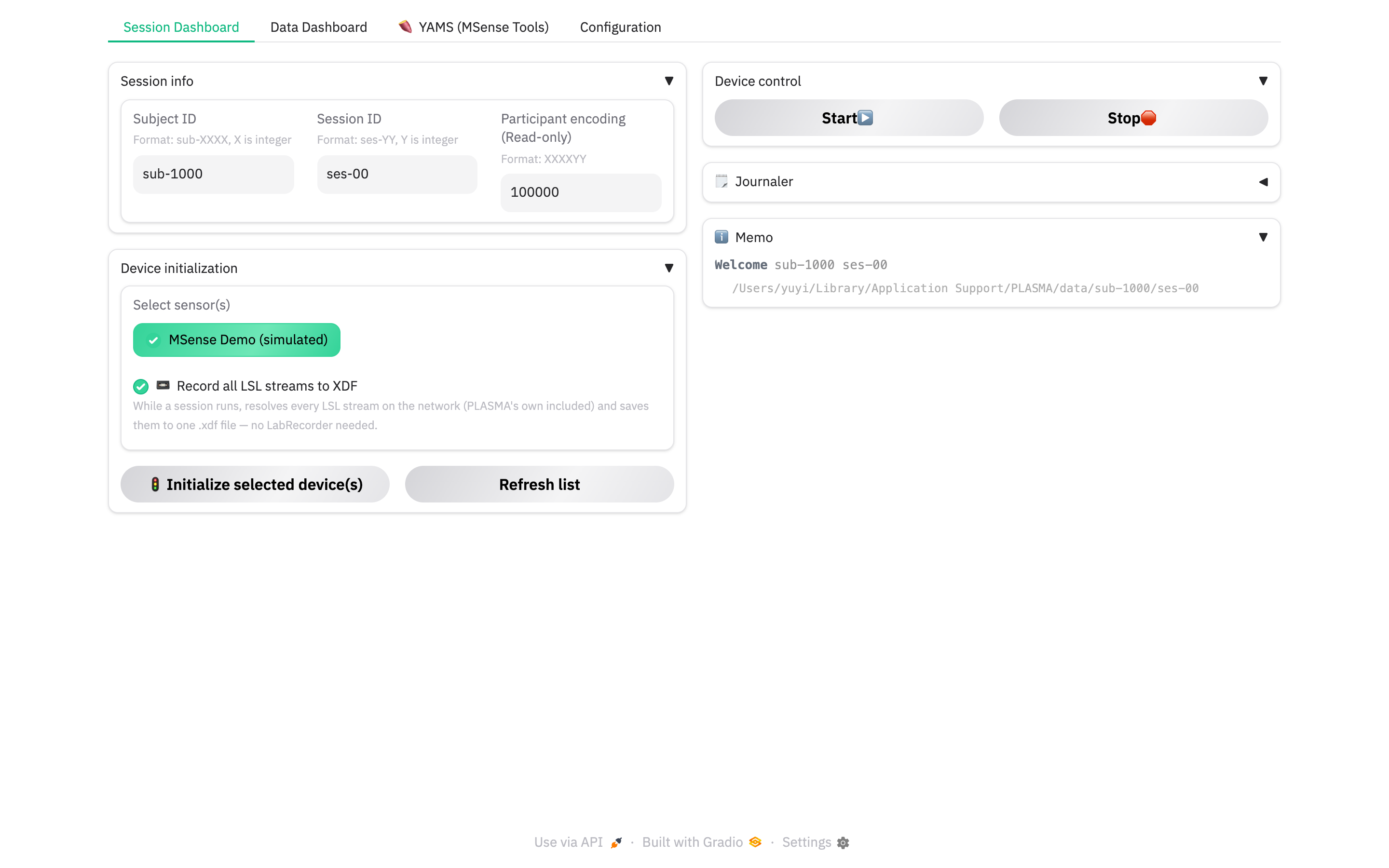
PLASMA opens on the Session Dashboard. The tab strip across the top is:
- Session Dashboard — enter IDs, initialise devices, Start / Stop, watch the memo.
- Data Dashboard — live per-channel plots of any stream.
- 🍠 YAMS (MSense Tools) — wristband signal-quality, orientation, download, extract.
- Configuration — the device catalog, network addresses, demo mode, power.
The YAMS tab only appears when an MSense device (real or simulated) is enabled.
Next: Configure PLASMA.